
Clay County Arrests Today
Start with the Clay County Sheriff's Office Daily Bulletin. CCSO labels it "Arrest Information." Its newest view is the closest official source for same-day Clay County arrests. The sheriff lists no second URL labeled "24 hour arrests." Nor does CCSO promise it. The default page may not cover a complete rolling 24-hour interval. Read the date labels and controls during your visit rather than assuming the window. The bulletin records a booking event. It is separate from the CCSO Inmate Information catalog, which covers people currently incarcerated. Someone released or transferred may show in the arrest bulletin but not the roster. A booking still being processed can appear in either tool later. When timing matters, search both and note when each check was made.
Check Clay County Arrests
Search with a known name and date, not a face alone. PoliceToCitizen is a vendor platform. Both links above are official. CCSO publishes them on its Crime and Arrest Information page. The safest sequence runs from the new-event feed to current custody. Then it goes to the records custodian.
- Open the official Daily Bulletin and inspect the newest visible date. Note whether the interface calls the event an arrest, incident, or booking.
- Compare the full name, event date, agency, and charge details. Similar names are common, so use more than one field.
- Check the official Inmate Information catalog if the question is whether the person is still held at the Clay County Jail.
- If neither tool settles the question, call CCSO Public Records at (904) 529-6090 or submit a focused request through the Public Records Center.
- Use the Clay County recent arrests hub when a booking copy, photo request, court disposition, or state custody route is needed.
The CCSO source page explains how arrest and inmate information are separated. The official page links to both services.
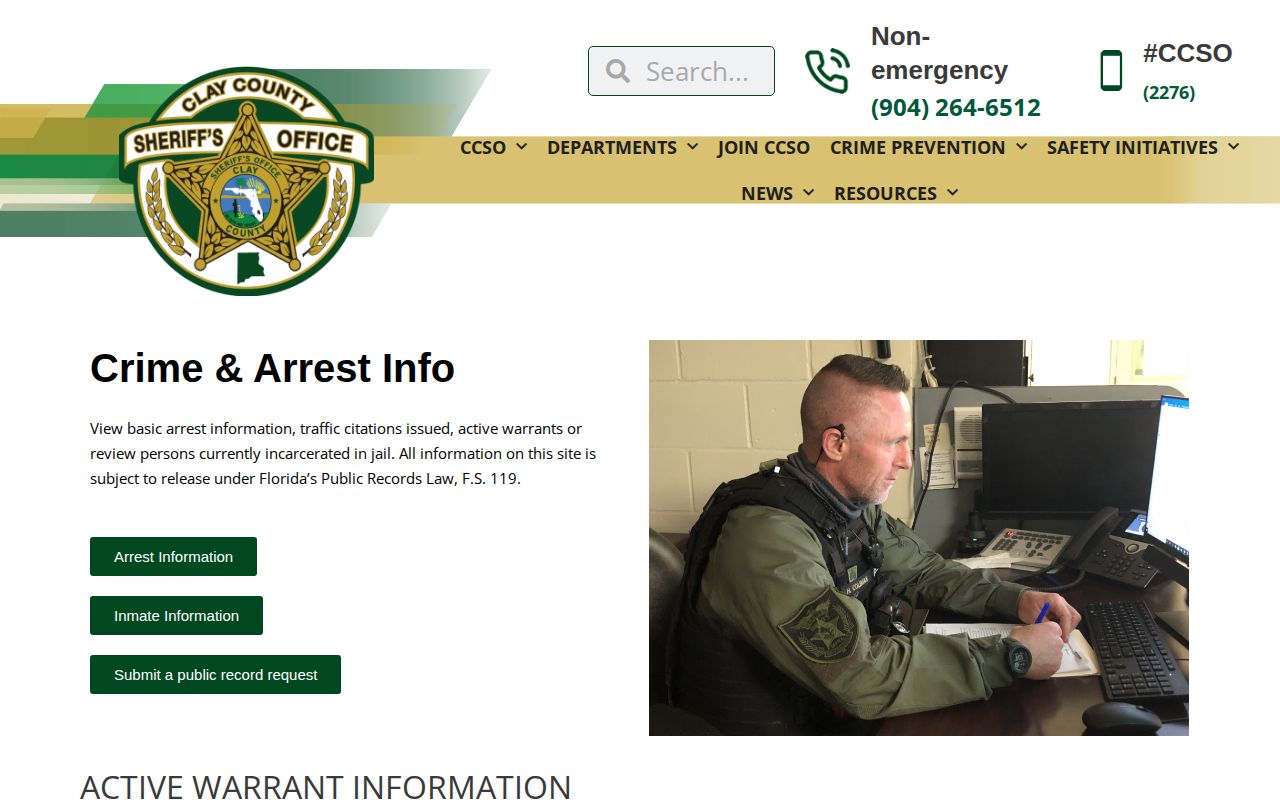
The screen separates new arrests from current custody.
Clay Arrest View Fields
The live bulletin builds its display when it loads. So the exact field order can vary. Florida's GS2 schedule covers commitment and release lists. It describes fields that a 24-hour record series may hold. The public vendor view can show fewer of them. Confirm what the screen actually displays before relying on any single item.
| Field to check | How to use it |
|---|---|
| Name and booking number | Match the person and preserve the most useful request identifier. |
| Arrest or booking date | Confirm that the event belongs to the same-day period being reviewed. |
| Arresting agency | Shows which agency created the arrest report, which may differ from the jail custodian. |
| Charges at booking | Records charges entered at intake. |
| Bond or release data | May describe an order or method; it does not by itself prove release is complete. |
| Photo, if displayed | Use only as one identity aid. CCSO does not promise a photo for every entry. |
"Booking" means the jail intake process itself. Identity, charge, property, and custody details get recorded there. The later "disposition" is the court result, such as a dismissal, plea, acquittal, or sentence. Follow the case through the Clay County Clerk when the outcome matters.
When Clay Bookings Lag
A fresh Clay County arrest passes through transport, intake, classification, image association, and data entry. No official page gives a fixed minute count for those steps. Release paperwork can also reach the booking room in its own order. A family member may not expect that sequence. A Saturday-night arrest may show up after your first check. That lag does not mean the site failed. Try the current inmate catalog next; the sheriff-linked catalog is the official current-custody tool.
This interface answers present custody better. It does not replace a full daily arrest sequence. For an urgent status question, call CCSO's non-emergency number, (904) 264-6512. For a copy, the Public Records Section can help. Staff there can search by full name, approximate date, booking number, and document type. A VINELink Check can add release or transfer alerts once a matching custody record appears. The Clay County Arrest Log suits reviewing several dates instead of one current slice.
Clay Arrest Charges Are Accusations
An arrest entry reflects what officers and booking staff recorded at intake. It is a snapshot of that moment. Charges may later be amended, reduced, declined, or dismissed. The court docket, not the roster, shows where the case ended up.
Names can differ between the booking and court systems, and one arrest can spawn more than one case. Compare the booking date, agency, case number, and other identifiers. A photo or name match alone is not enough. The roster answers custody; the docket answers the case.
CCSO App Arrest Shortcut
The CCSO mobile app bundles an inmate search tool with the latest sheriff news. It is a shortcut, not a second booking system. The sheriff's office makes no promise that the app posts arrest data faster than PoliceToCitizen or runs its own photo feed. Some features just link out to older tools. Open it and see which service loads. Sheriff news posts can describe agency activity. Still, a story about a Clay County arrest is not the same thing as a same-day booking list.
Fugitive Friday sits in a different lane. The two are easy to mix up. That weekly feature highlights wanted people, not people booked into the Clay County Jail today. Keystone Heights gets police service through a county partnership. Green Cove Springs and Orange Park police can make an arrest, yet both municipal agencies say the booking happens at the county jail. So the arresting agency may be a city department while CCSO holds the custody record. Ask the police department for an incident report. Ask the sheriff for the booking record and current detention status.
The live catalog stops answering after release. A booking record can still be requested from CCSO. The court case continues either way. A sentence into Florida state custody moves the person out of this feed entirely. That person belongs in the Florida Department of Corrections Offender Search. Different systems, different stages. A missing result in one source should point you to the next correct one rather than to a broad conclusion. Do not treat an empty search as final.
Note: Write down the time and source of any check, because a custody result can change after release or transfer.
Public Record Search
Sponsored Results