
Clay County Recent Arrest Sources
The sheriff's office splits one common question into two. Its Crime and Arrest Info page points to a Daily Bulletin for arrests tied to a date and to an Inmate Information catalog for people in jail now. A new Clay County arrest passes through transport, intake, classification, and data entry first. No tool posts on a fixed clock. A missing name in one view does not mean the arrest never happened.
The Daily Bulletin is the county's only official arrest feed. One address serves it. The same page handles a current-day check and wider date searches. Controls decide the range. Clay County does not publish separate URLs for the two windows.
| Question | Best official starting point | What to verify |
|---|---|---|
| Who was booked today? | CCSO Daily Bulletin | Date, name, agency, and any displayed event detail |
| Who appears in custody now? | CCSO Inmate Information catalog | Identity fields, charges as booked, and custody listing |
| What happened over several days? | Daily Bulletin date controls | Selected dates, delayed entries, and duplicate events |
| What if the portal fails? | CCSO Public Records Section | Booking date, record type, and matching identifiers |
Need same-day results? The 24 Hour Arrests page covers fresh Clay County bookings. For wider or older date checks, the Arrest Log lists bookings across several days.
When Clay Arrests Appear
Green Cove Springs and Orange Park hold arrestees briefly at the municipal level. Transport to the Clay County Jail follows. Keystone Heights gets police service through a sheriff partnership, so the same booking system applies there. Jail staff finish intake before anything goes public. Paperwork can lag the street arrest. The jail promises no fixed update interval.
Checking on someone arrested last night? Start with the Daily Bulletin. Then compare the inmate catalog. If the name is still absent, call the Public Records Section or file a focused request. The VINELink Check adds release or transfer alerts once a record matches. It does not replace direct jail confirmation.
Search the Clay Jail Roster
CCSO's Inmate Information catalog is the current-custody route. It is not a full arrest history. Someone arrested in Clay County can leave the catalog at release while the booking record and court docket live on. Search fields, photo placement, refresh timing, and retention vary, so confirm them in the live interface rather than assuming. Check the catalog itself.
| Field to compare | Why it matters |
|---|---|
| Full name | Start with the legal name and test known spelling variants. |
| Booking number | Separates bookings and gives the records unit a precise identifier. |
| Booking date | Distinguishes a fresh intake from an older event. |
| Age and physical details | Help separate people with the same or similar names. |
| Arresting agency | Identifies which office may own the arrest report. |
| Charges and bond | Shows intake charges and an initial bond entry, not case outcome. |
Use the roster in a short, careful sequence:
- Open the official catalog from the CCSO Crime and Arrest Info page.
- Search the full name, then compare several identity fields before accepting a match.
- Record the booking number and date if displayed. Use those values for a court or records query.
- Check the Clay Clerk docket for later case events. Contact CCSO when the roster cannot answer the custody question.
The CCSO mobile app lists inmate search among its features. Think of it as a shortcut. It draws on the same data. CCSO promises no separate update cycle or photo feed.
For live custody checks, open the official current-inmate catalog in the police-to-citizen system.
The capture identifies the county’s current-custody route without reproducing a gallery of booking photos.
Where Clay Arrest Records Publish
Clay County arrest details can sit in several systems. Each answers a different question. Official county sources come first; a newspaper story or copied listing may be stale, incomplete, or unable to confirm current custody.
| Channel | Official? | Use and photo limits |
|---|---|---|
| CCSO Daily Bulletin | Official-linked | Recent arrest events by date; current photo behavior must be verified live. |
| CCSO inmate catalog | Official-linked | Current custody; no promise that every entry has a photo. |
| CCSO records request | Official | Booking cards, arrest reports, and booking-photo copies subject to law and redaction. |
| Clay Clerk inquiry | Official | Court filings and dispositions, not a live jail roster. |
| Clay Today issue archive | No | Selected weekly arrests and police briefs; not complete or live. |
| Commercial county pages | No | Copied records may outlast source changes and must be checked against official records. |
CCSO’s source page visibly groups Arrest Information, Inmate Information, and public-record access:
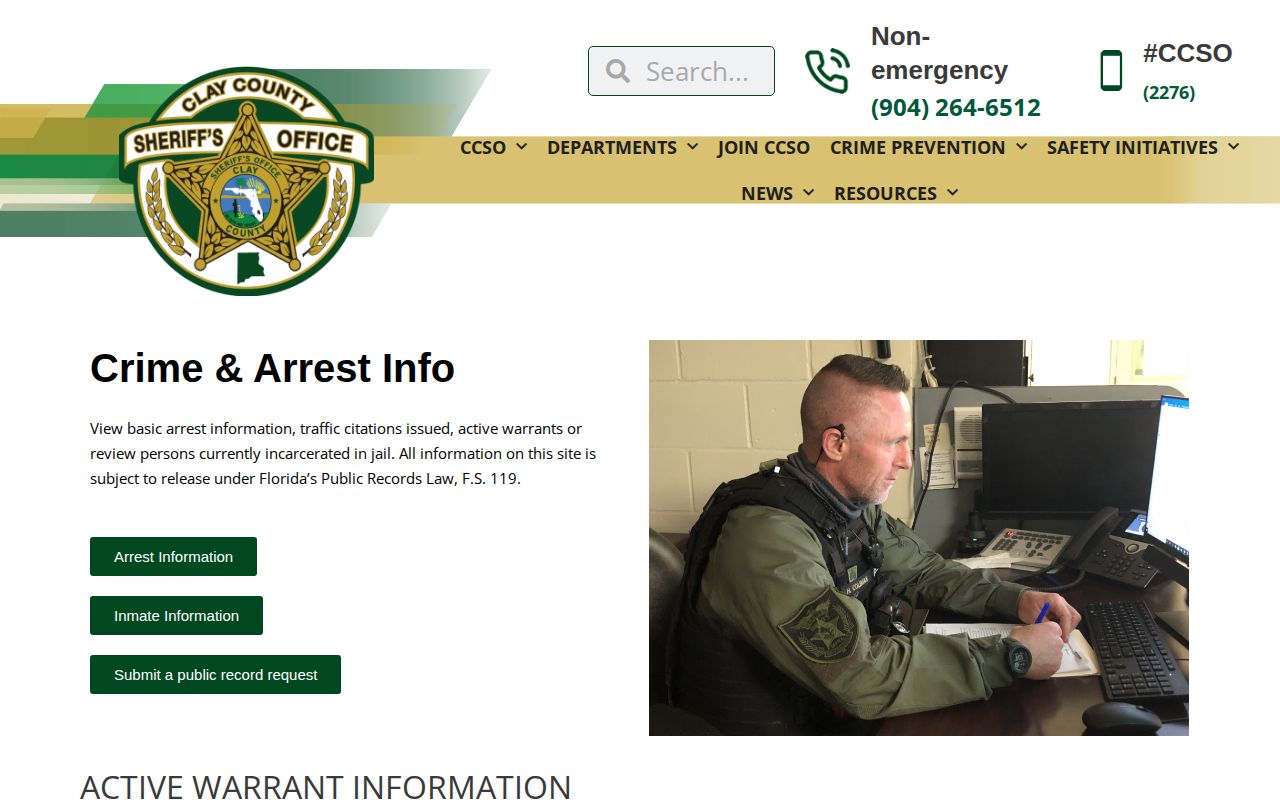
That official routing is the safest first step. Does a copied listing prove present custody? No, because an arrest page can outlast a release or charge change. Confirm the name in the CCSO catalog and check the court case.
Recent Arrests by City
The three city pages track incorporated cities, not larger unincorporated areas. Each city polices differently on the front end, but every booking record converges at the Clay County Jail.
- Green Cove Springs Recent Arrests covers the Green Cove Springs Police Department, its monthly activity reports, and transfer to the county jail.
- Orange Park Recent Arrests covers Orange Park Police records and the town’s county-jail booking route.
- Keystone Heights Recent Arrests explains the city’s county public-safety partnership and direct CCSO route.
A city police report and a jail booking entry are separate records. Ask the arresting agency for the incident report. CCSO holds the booking card or booking photo when the county jail created it.
Clay County Booking and Release
The CCSO detention page describes a 490-bed Clay County Jail. Capacity is a facility fact. It is not an annual arrest count. The sequence runs from arrest and transport to jail intake. Then comes booking entry and first appearance or bond action. Release, transfer, or continued detention follows. A bond figure at intake does not prove it was posted or that release happened.
| Stage | Record owner | What the record answers |
|---|---|---|
| Arrest or incident | Arresting police agency or CCSO | Why custody began and the officer’s report |
| Booking | Clay County Jail | Intake identity, charges, booking number, and possible photo |
| Current custody | CCSO inmate catalog | Whether the person is presently listed |
| Court case | Clay County Clerk | First appearance, filings, orders, and disposition |
| Release or transfer | Jail and receiving agency | Change in custody, which may post after paperwork arrives |
The jail FAQ ties release processing to paperwork reaching the booking room. No fixed release-to-removal interval is given. That gap matters. Treat a bond amount, a VINE alert, and the live roster as three related facts, not one final answer.
Inside a Clay Arrest Record
A booking record starts when a person enters custody. Florida's official GS2 records schedule lists what the file may hold: an intake form, booking card, arrest record, physical and demographic details, booking number, charges, arresting and booking officer, time and place of arrest, and a probable-cause summary. Public portals show only part of that file. The agency keeps the rest.
| Field | What it shows |
|---|---|
| Name and identifiers | The person recorded at intake; compare more than the name alone. |
| Booking number and date | The specific custody event and when jail intake was recorded. |
| Arresting agency | The office that may hold the underlying report. |
| Charges as booked | Charges entered at intake, not a conviction or final charge. |
| Bond | An amount or status recorded at that point, not proof of release. |
| Photo | An intake image when law and agency practice permit public access. |
| Release or custody status | A changeable jail fact that may lag paperwork. |
Clay County Mugshots and Photos
Start with the official inmate catalog when you want a current Clay County booking photo. CCSO makes no promises here. Not every person in custody gets a photo posted. Display periods vary too. When no image appears, the CCSO Public Records Section accepts requests for booking photos, and its fee sheet prices them at $0.15 per page, though the listed rate guarantees no particular electronic format. A second, separate system exists at the state level. The Florida Department of Corrections keeps profiles through its Offender Search, which covers state prison and state supervision rather than recent Clay County booking activity. FDC lets users hide photos on list pages. A detail page can show an available image. State photos refresh weekly. Location and date fields update nightly. An empty FDC result, in short, tells you nothing about a recent county arrest. The official FDC search and detail navigation shows how those pages are organized.
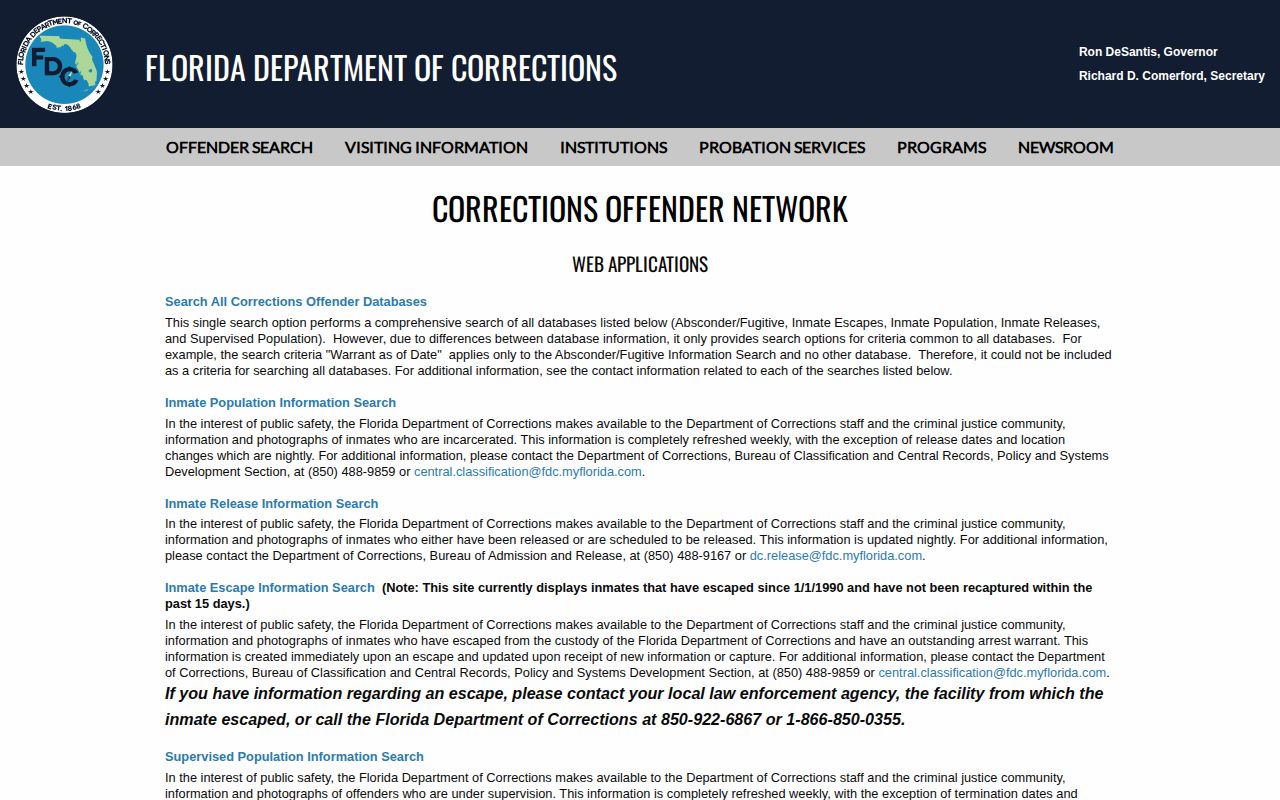
A state inmate locator answers a different question than a Clay County mugshot or jail roster search. The two tools should never be confused. Commercial sites and newspaper archives often keep booking photos long after the official record changes, since they hold no custody authority at all. This page offers no photo gallery and does not rehost those images.
Request a Clay Arrest Record
The CCSO request page takes anonymous requests and asks for no reason. The online Public Records Center works too. Phone, mail, or a walk-in visit all work. Written requests go to the Clay County Sheriff's Office, Attn: Public Records Section, 901 N. Orange Ave., Green Cove Springs, FL 32043. The records line is (904) 529-6090.
- Identify the person, approximate arrest or booking date, arresting agency, and booking or case number if known.
- Name the exact item wanted, such as the booking card, arrest report, release entry, or booking photo.
- Choose the online center, phone, mail, or in-person channel. Ask for electronic delivery when that format is useful.
- Review any cost estimate and narrow the request if broad research or redaction would create added charges.
- When material is withheld, ask the custodian to identify the legal exemption and produce the nonexempt remainder.
Fees are modest on the CCSO sheet. Letter-size single-sided copies run $0.15. Certified copies cost $1.00. Booking photos are billed at $0.15 per page, and extensive work is charged at actual cost. Florida law sets no universal day count for every record request, so CCSO should acknowledge and produce records within a reasonable time based on review, redaction, and scope. The CCSO Public Records Center is the landing page where an online arrest record request begins.
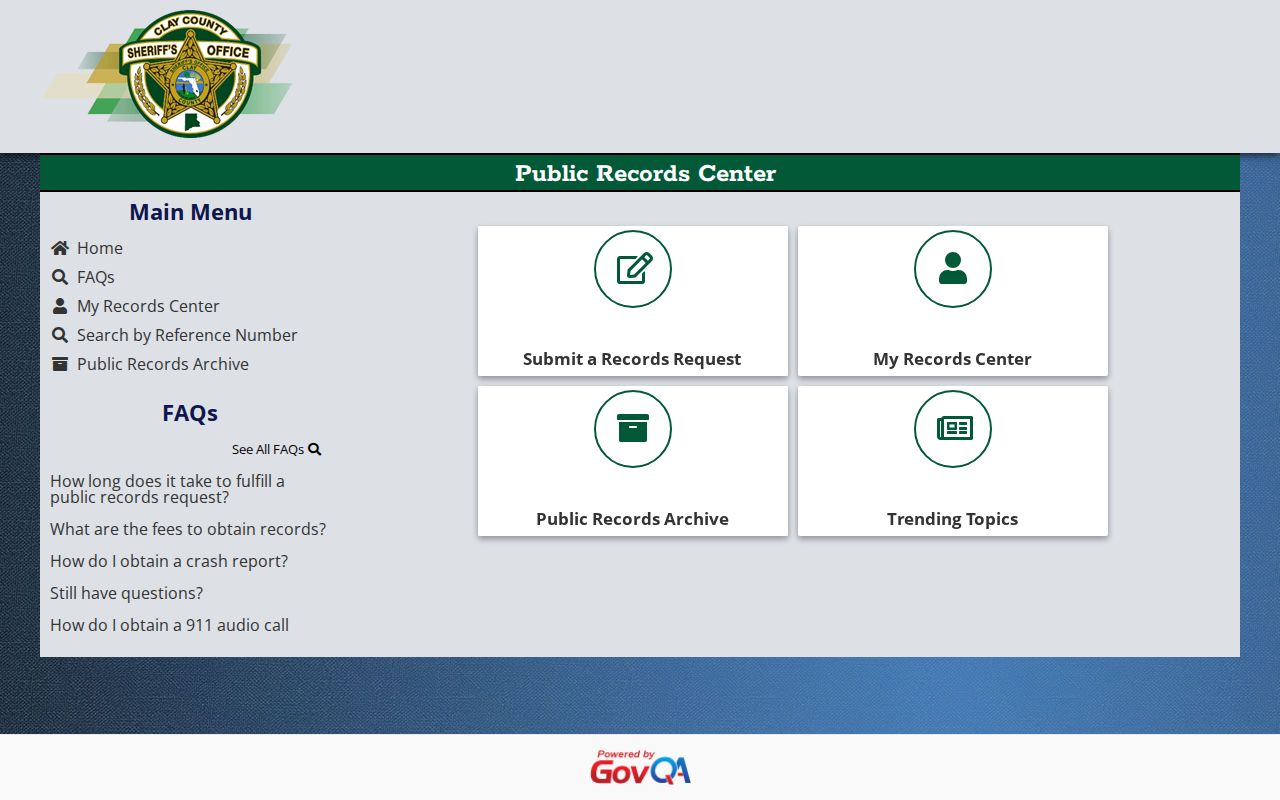
The stable landing page is safer to save than a session-specific request URL.
Florida Arrest Records Law
Florida Statutes §119.07 gives a general right to inspect and copy public records. Exemptions are carved out. Nothing in the law forces an agency to post every record online. Victim details, active investigative material, protected medical facts, and juvenile information may be redacted. The rest of the file is still produced.
A second law targets paid booking-photo publishers. Florida Statutes §901.43 bars a covered commercial publisher from charging a fee to remove an arrest photo. Covered people or their legal representatives can mail a written request, registered, to the publisher's registered agent. Identity proof and image detail must be included. Removal has to be free. It must finish within ten calendar days of receipt. The statute has limits, though. It does not impose the same duty on every county page, newspaper mention, or search result.
Begin any correction with the office or publisher that controls the source. Keep the URL, the request, proof of delivery, the response, and any court order. A demand for payment is a warning sign. Never pay for a remedy Florida law may require a covered publisher to provide for free.
Withheld Clay Booking Records
Florida's juvenile-record statute keeps most juvenile-justice information confidential. Specified felonies and adult-court cases are exceptions. Even then, a custodian may decline to publish a child's booking photo online. A blank result can mark a legal boundary. It does not mean the lookup failed.
Adult records follow other rules. FDLE notes that a dismissal, nolle prosequi, or withheld adjudication does not automatically erase a public criminal-history record. The usual path starts with an FDLE Certificate of Eligibility, followed by a petition and affidavit filed with the court. That certificate is not the sealing or expungement order itself. The Clay Clerk supplies the local forms used once eligibility is set.
- Sealed
- Restricted from ordinary public access while authorized agencies retain access permitted by law.
- Expunged
- Handled under a stronger court-ordered remedy with limited lawful access remaining.
- Disposition
- The court’s later result, which can differ from the charge written at booking.
Older Clay County Arrest Files
A web page rolling off the roster is not record destruction. Florida's GS2 retention schedule treats booking records, arrest reports, inmate files, commitment and release lists, and other jail material differently. The exact series controls the retention rule, and a litigation hold, investigation, or audit can extend it.
For an older Clay County arrest, start with CCSO. Describe the record type and date range you want. Ask whether the office still retains the file, transferred it, or lawfully destroyed it under schedule. The Florida State Archives holds no promised Clay booking-photo collection. It serves only as a later archival route. That comes after the creating agency and its records staff have been exhausted.
Search engines can help when a corrected page lingers. Outdated-content tools refresh an old cached result. That changes the search copy, not the source record. A newspaper or commercial copy of the same arrest may need its own no-fee correction or removal request under that publisher's policy and applicable law.
Clay Warrants and Wanted Posts
Wondering about a warrant in Clay County? CCSO keeps things close. The sheriff posts no active-warrant list online, and phone clerks will not confirm one either. Its official instruction tells anyone checking their own status to show up at headquarters or an operations center with photo ID. The weekly arrest bulletin is a separate thing entirely.
For a statewide lead, the FDLE Wanted Persons system covers every Florida county, Clay included. Enter a name and it may return a reporting agency plus a photo icon. FDLE cautions that entries can lag, so treat a hit as a starting point. Confirm anything directly with the agency that filed it.
Wanted names in Clay also surface through CCSO's Fugitive Friday posts, short videos spotlighting people deputies want to find. The page doubles as an archive, which makes it a poor gauge of who is wanted right now. Spot someone? Don't play deputy. Call CCSO at (904) 264-6512 or tip First Coast Crime Stoppers at TIPS (8477). Worried a warrant carries your own name? An attorney or the clerk of court can help you sort it out.
Note: The official Fugitive Friday page displays each week's wanted-person videos and posts.
The page offers agency context, not a gallery. Older posts may no longer be active.
After a Clay County Arrest
After a Clay County arrest, the paper trail moves to the courthouse. The Clay Clerk Search Records page opens the court inquiry portal. You can search by legal name there. Case number, date, or other identifiers also work. A booking number helps link things together, but the court system files everything by case. Uncertified copies can be viewed online free. Anything not posted can be requested from the Clerk's Records Management Liaison Officer.
What should you look for? Expect first appearance and bond orders. The charging document, arraignment, motions, pleas, disposition, and sentence or release orders follow. An arraignment is where the charge and plea get addressed. Disposition means the final result. Both can look quite different from that first booking page.
Clay Records Beyond County Custody
Release from the Clay County jail doesn't always mean custody ends. A person can move to another county, Florida state prison, federal detention, or ICE custody. Each path has its own lookup. FDC tracks state incarceration and supervision by DC number. The Federal Bureau of Prisons locator covers federal inmates from 1982 forward. It shows no public mugshot gallery. Its release dates can shift after sentence review.
The ICE Online Detainee Locator works differently. Search by A-number and country of birth, or by exact biographical details. It covers current ICE custody. It also covers some Customs and Border Protection holds past a set threshold. Minors cannot be searched there. A jail entry and an ICE result may update on different schedules.
U.S. Marshals Service prisoners often sit in local, state, or private facilities before sentencing. There is no nationwide public USMS roster like the Clay catalog, though. Federal custody questions go to the responsible court, district office, or holding facility. None of these locators replaces the Clay County booking record.
Clay County Sheriff’s Office Location and Directions
Search Public Records
Sponsored Results